How to play college football is a question every competitive football family asks — but the answer depends entirely on what "college football" means for your athlete. There are over 1,600 college football programs across FBS, FCS, D2, D3, and NAIA. The path isn't reserved for five-star recruits and Power Four commits. It's available to any athlete willing to honestly assess where he fits, invest in the right evaluation opportunities, and run a disciplined recruiting process that matches his level.
The mistake most football families make is treating the recruiting process as a single pipeline that either works or doesn't. In reality, FBS, FCS, D2, D3, and NAIA recruit differently, evaluate differently, offer different scholarship structures, and operate on different timelines. An athlete who gets zero FBS attention may be a full-scholarship FCS recruit. A player overlooked by every D1 program may start four years at D2 and have the best college experience of his life. Understanding the landscape is the difference between a four-year career and four years of frustration.
Before spending money on camps, highlight reels, and recruiting services, every family needs to answer the foundational question: at what level can my athlete realistically compete?
The measurables that matter. College football coaches evaluate objective athletic data as a first filter. The specifics vary by position, but the core metrics include 40-yard dash time, shuttle time, vertical jump, broad jump, height, weight, and position-specific skills (arm velocity for quarterbacks, get-off speed for defensive linemen, coverage ability for defensive backs). These numbers determine which division's rosters your athlete belongs on.
General benchmarks by position group and level:
| Measurable | FBS (Power 4) | FBS (Group of 5) / FCS | D2 | D3 / NAIA |
|---|
| 40-yard dash (skill positions) | 4.4–4.6 sec | 4.5–4.7 sec | 4.6–4.8 sec | 4.7–5.0 sec |
| 40-yard dash (linemen) | 4.9–5.2 sec | 5.0–5.3 sec | 5.1–5.5 sec | 5.2–5.6 sec |
| Vertical jump (skill) | 34–40+ in | 30–36 in | 28–34 in | 26–32 in |
| Bench press (225 lbs, linemen) | 20–30+ reps | 15–25 reps | 10–20 reps | 8–15 reps |
| Height/weight (OL) | 6'3"+ / 290+ | 6'2"+ / 275+ | 6'0"+ / 260+ | 5'11"+ / 245+ |
| Height/weight (WR) | 5'11"+ / 185+ | 5'10"+ / 175+ | 5'9"+ / 170+ | 5'8"+ / 160+ |
These are ranges, not cutoffs. A quarterback who runs a 4.8 forty but reads defenses at an elite level and throws with anticipation will get FCS and D2 looks that a faster, less cerebral quarterback won't. A 5'10" defensive back with a 4.5 forty and elite ball skills may draw FBS interest despite being undersized. The measurables open doors — film and game performance determine which doors lead to offers.
For position-specific benchmarks in full detail, our football recruiting standards guide breaks down what coaches expect at every division level.
The honest conversation. If your son is a 5'9", 160-pound junior running a 4.9 forty, targeting SEC programs is not a plan — it's a fantasy that wastes time and money. That same athlete may be an all-conference D3 safety or a four-year NAIA starter. The families who succeed are the ones who target the level where their athlete genuinely fits, not the level they see on television.
FBS football (133 programs). The highest competitive and financial level. FBS is split into Power Four conferences (SEC, Big Ten, Big 12, ACC) and Group of Five conferences (AAC, Sun Belt, Conference USA, MAC, Mountain West). Power Four programs recruit nationally, dominate television revenue, and offer the most resources. Group of Five programs recruit regionally and produce competitive teams that occasionally crack the national picture. For the full D1 program landscape, see our D1 colleges for football guide.
FCS football (130 programs). The second tier of D1. Under the new roster limit model (effective 2025-26), FCS programs share the same 105 roster-limit scholarship structure as FBS — a significant upgrade from the old 63 equivalency system. FCS football is highly competitive and includes storied programs in conferences like the CAA, Missouri Valley, Big Sky, and SWAC. Many FCS programs recruit athletes who were on the margins of FBS recruiting boards, and the quality of play is higher than most families expect.
D2 football (170+ programs). D2 offers 36 equivalency scholarships per program. The athletic commitment is regulated at 20 hours per week during season, providing a more balanced student-athlete model. D2 football is the sweet spot for strong regional athletes — the competition is real, the scholarship money helps, and the college experience includes time for academics and campus life.
D3 football (250+ programs). No athletic scholarships, but D3 has the most football programs of any division. Academic merit and need-based aid can be substantial — especially at private liberal arts colleges where D3 football is concentrated. The recruiting process is the most accessible: no calendar restrictions, direct coach communication, and roster sizes that create real playing time opportunities.
NAIA football (90+ programs). NAIA programs offer up to 24 equivalency scholarships with more packaging flexibility than NCAA divisions. No recruiting calendar restrictions make the process faster and more direct. NAIA football suits athletes who want competitive football at smaller schools with strong campus communities.
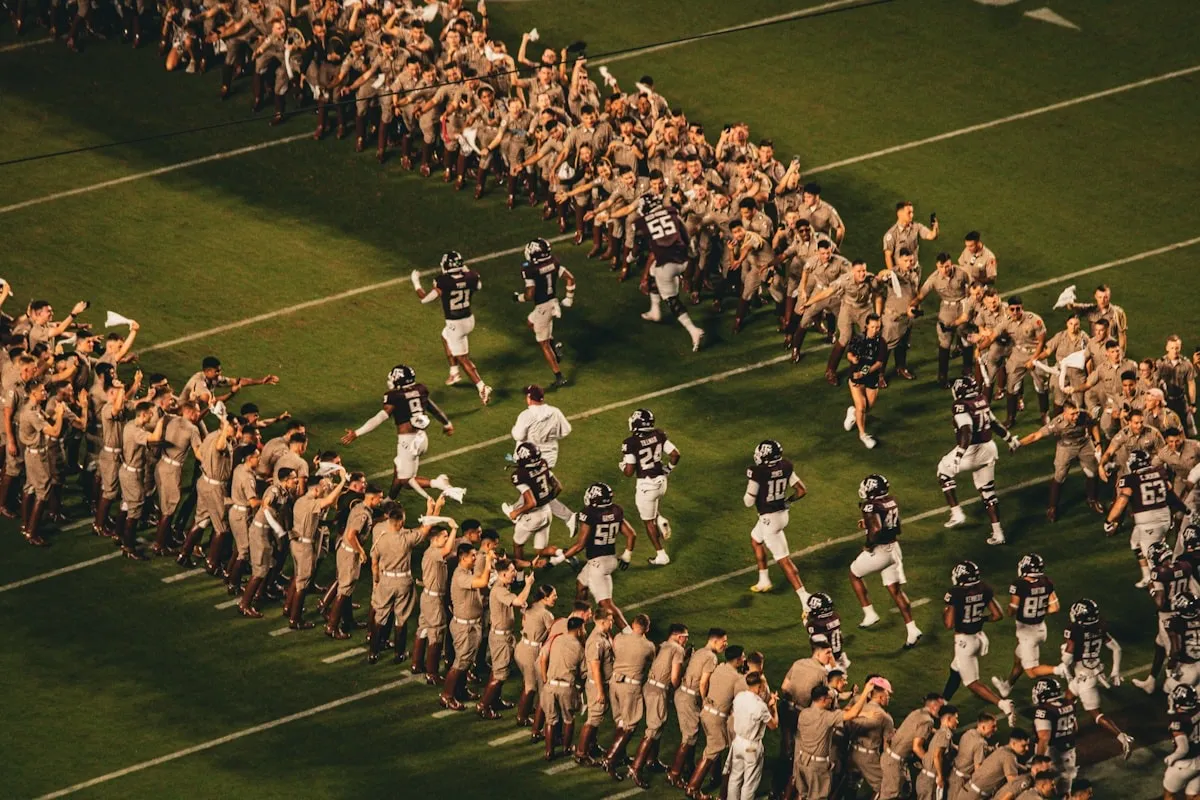
Football recruiting operates through two parallel evaluation channels: game film and in-person camps. Both matter — but film is the foundation.
Film is your recruiting currency. Unlike baseball (showcases) or basketball (AAU), football coaches make their initial evaluation from Hudl or film links before they ever see an athlete in person. A well-edited highlight reel that shows 8–12 plays of your athlete's best work — plus full-game film that demonstrates consistency — is the baseline requirement for any recruiting conversation. No film means no evaluation. For how to build effective film, see our guide on creating a recruiting highlight reel.
The critical timeline:
| Year | What should be happening |
|---|
| Freshman–Sophomore | Develop athletically — speed, strength, and football IQ. Start filming varsity games and building a Hudl profile. Create a target list of programs. No camp investment needed yet. |
| Sophomore spring/summer | Attend 1–2 college camps at regional programs to get evaluated and build relationships. Send introductory emails to 20–30 programs with film and measurables. |
| Junior year | The peak evaluation window. Attend 2–4 college prospect camps at target programs. Email every target coach before and after each camp. Update film after each season. This is when most FBS and FCS offers are made. |
| Senior fall | Early signing period (December). Most FBS and FCS rosters are largely set. D2, D3, and NAIA opportunities remain available through National Signing Day (February) and beyond. |
The camp system. College-run prospect camps and mega camps (where multiple schools' coaches evaluate simultaneously) are the primary in-person evaluation format. A $50–$200 camp where a coaching staff watches your athlete compete in position-specific drills and one-on-ones is the most direct evaluation path in football. Third-party combines that charge $200–$500 for 40-yard dash times and shuttle results are generally lower-value — coaches want to see your athlete compete, not run timed drills. For the full camp evaluation framework, see our guide on whether football recruiting camps are worth it.
For the month-by-month recruiting calendar across all divisions, see the football recruiting timeline and the NCAA football recruiting calendar.
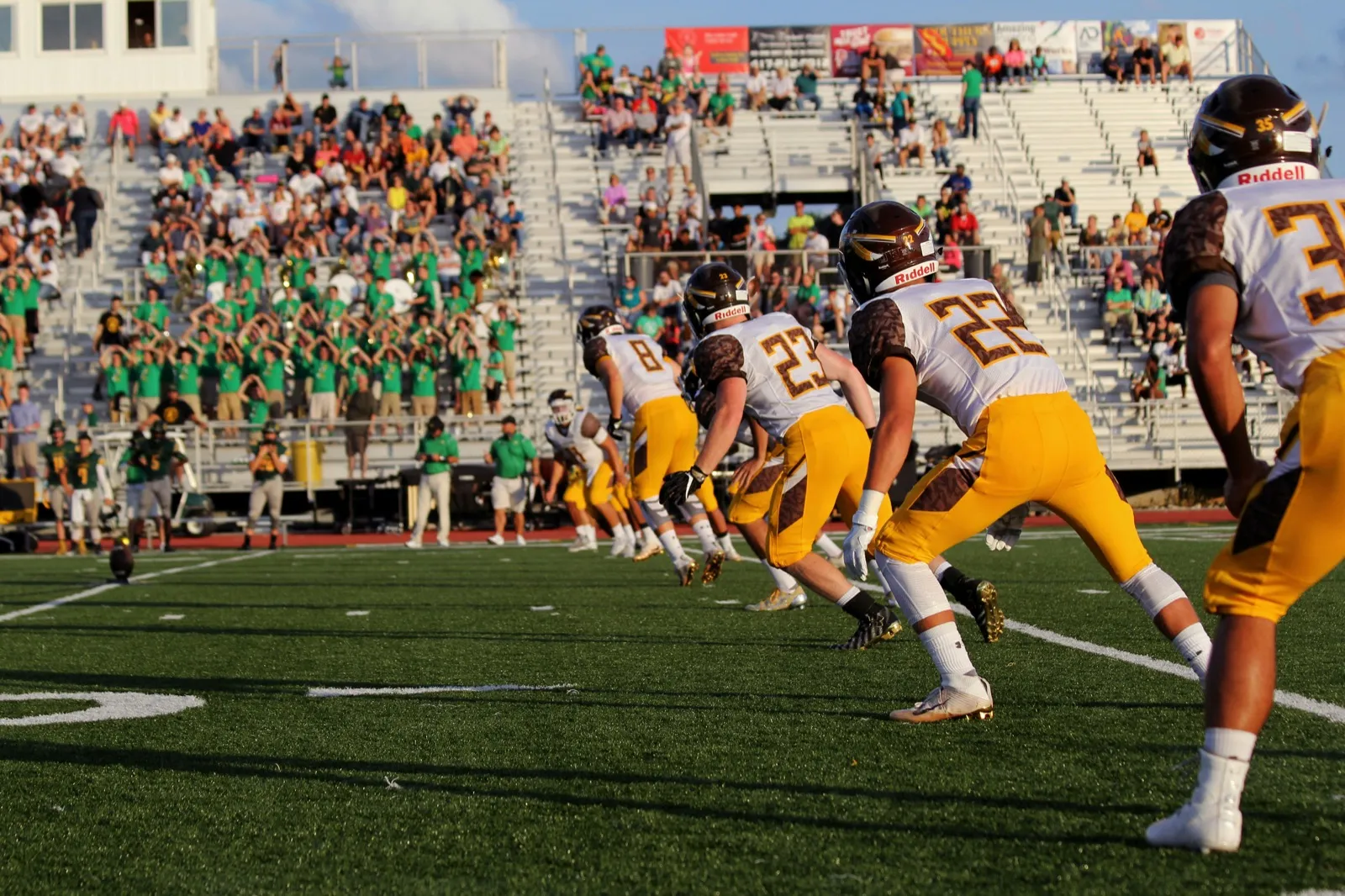
Football's scholarship structure is the most complex in college athletics — and it changed significantly under the House v. NCAA settlement effective 2025-26.
FBS: 105 roster-limit scholarships. Under the new roster limit model, FBS programs can carry up to 105 scholarship players — up from the old 85 headcount limit. Schools can now offer full scholarships to every rostered player, and at FBS most do: a scholarship player typically receives 100% of cost of attendance. Walk-on programs remain common and legitimate — many walk-ons earn scholarships after proving themselves on the roster.
FCS: 105 roster-limit scholarships. FCS football now operates under the same 105 roster-limit model as FBS — a major increase from the old 63 equivalency limit. Schools can now offer full scholarships to every rostered player. In practice, most FCS programs still distribute their budget as partial awards across rosters of 85–100+ players. A 75% FCS scholarship at a school with $30,000 annual cost leaves a family paying $7,500/year, which competes favorably with many FBS walk-on situations.
D2: 36 equivalency scholarships. Split across rosters of 80–100 players, D2 football scholarships average 25–50% of cost of attendance. At D2 tuition levels, the net cost is often lower than an FCS partial award at a more expensive institution.
D3: Zero athletic scholarships. Academic merit and need-based financial aid can cover 40–70% of tuition at private D3 colleges. A D3 player receiving $30,000 in academic aid at a $50,000 school has a comparable financial outcome to a 60% D2 scholarship at a $30,000 school.
NAIA: Up to 24 equivalency scholarships. NAIA programs package athletic, academic, and need-based aid more flexibly than NCAA programs, often producing total packages that exceed what lower-tier D2 programs offer per athlete.
For the complete scholarship math across every division, see the football athletic scholarships guide.
The step-by-step path from high school player to college roster
Step 1: Build your film library (freshman year onward). Film every varsity game. Create a Hudl profile. By the end of sophomore year, you should have a curated highlight reel (8–12 plays showing your best work from multiple angles) and links to two or three full games.
Step 2: Get verified measurables (sophomore spring). Attend a college camp or combine and record your 40-yard dash, shuttle, vertical jump, height, and weight in a verified setting. Self-reported numbers carry no weight — coaches want verified data.
Step 3: Build a realistic target list (sophomore spring). Based on your measurables, position, film, and academic profile, identify 20–30 programs across 2–3 divisions where the fit is genuine. Don't target exclusively up — include programs at every tier where your athlete can compete for playing time. For the framework, see our guide on how to build a college recruiting target list.
Step 4: Start outreach (sophomore spring through junior fall). Email the position coach and recruiting coordinator at every target program. Include your Hudl link, measurables, academic information, and one genuine sentence about why you're interested in their program. For the template, see our guide on how to email a football college coach.
Step 5: Camp strategically (junior summer). Attend prospect camps and mega camps at programs where you've already initiated contact. Email the coaching staff two weeks before each camp. Perform. Follow up within 48 hours. A strong camp performance with prior outreach is how most non-elite recruits earn their first offer.
Step 6: Evaluate offers and commit (junior fall through senior December). Compare net cost, playing time opportunity, development culture, academic fit, and coaching staff stability. A full scholarship at a program where your son sits behind three recruited players at his position is worth less than a partial scholarship where he competes for a starting job immediately.
The bottom line
Playing college football is achievable for far more athletes than most families realize — but the path requires an honest assessment of level, smart film production, disciplined camp attendance, and a recruiting strategy calibrated to the right tier. The families who succeed are the ones who understand that D3 and NAIA football are real opportunities — not consolation prizes — and who invest their time and money in the division where their athlete genuinely belongs.
For position-specific benchmarks that determine division fit, the football recruiting standards guide has the numbers. For the complete recruiting timeline across divisions, the football recruiting timeline maps the process. And for the email that starts the conversation with a college coach, the football coach email guide has the sport-specific template and timing. If you're deciding between free and paid platform options, compare best football recruiting websites. If you're specifically evaluating managed support, here's a football-specific look at whether NCSA is worth the investment.