Two things can both be true about college recruiting timelines. A Division I soccer program can extend a verbal offer to a 13-year-old who hasn't started high school yet. A D2 volleyball program can still be actively recruiting seniors well into spring of their final year. The same system operates on wildly different clocks depending on sport, division, and where your athlete sits in the talent distribution.
"Start early" is useless advice without knowing what "early" means for your sport. For a D1 soccer family, early is seventh grade. For a D3 baseball family, early is junior year. The mistake most families make is applying the timeline they've heard about — usually D1 football or basketball — to a sport where it doesn't apply. Or they panic about being behind when the process they're in, at their division and sport, is nowhere near over.
This article maps the active recruiting windows for seven major sport groups, explains what drives the differences, and gives you a grade-by-grade framework for knowing whether you're ahead, on track, or actually behind.
When the active recruiting window opens
Before the sport-by-sport breakdown, one foundational distinction matters: athletes can contact coaches at any time, at any division level, in any sport, with no restrictions. The regulations govern when coaches can initiate contact, not when athletes can reach out.
For D1 programs, the start of official recruiting contact varies by sport. For most sports — including soccer, basketball, and volleyball — coaches can begin initiating direct communication (calls, texts, emails, DMs) on June 15 after sophomore year. For football and men's lacrosse, the date is later: September 1 of junior year. For baseball, the contact date is August 1 before junior year. Men's ice hockey is the earliest outlier at January 1 of sophomore year. D2 programs follow similar frameworks with modest differences. D3 programs have minimal restrictions on when coaches can communicate with prospects — calls, texts, and emails are allowed at any time, though off-campus contact is restricted until after sophomore year — which is a significant reason why D3 timelines are so much more flexible. For the detailed definitions behind dead, quiet, contact, and evaluation windows, use NCAA recruiting periods explained.
The table below shows when serious recruiting activity — not just observation, but real contact and offers — typically begins for each sport at each level.
| Sport | D1 active window starts | D2 typical window | D3 typical window |
|---|
| Soccer | 9th–10th grade (some earlier) | Junior year | Junior–senior year |
| Football | Summer before junior year (FBS/FCS) | Junior–senior year | Senior year |
| Baseball/softball | Sophomore–junior year | Junior–senior year | Senior year |
| Basketball | 9th–10th grade (elite programs) | Junior–senior year | Junior–senior year |
| Lacrosse | Sophomore–junior year | Junior–senior year | Junior–senior year |
| Volleyball | Junior year | Junior–senior year | Senior year |
| Swimming/track | Junior year | Junior–senior year | Senior year |
What this table makes clear: D1 timelines are compressed and unforgiving. D2 and D3 timelines are more forgiving than most families realize. A junior who hasn't heard from any D1 programs isn't necessarily out of options — they may simply be in the wrong tier of the table.
Soccer: recruiting pressure starts before high school
D1 soccer runs on a timeline that genuinely alarms parents whose athletes play other sports. Elite programs — those competing at the national level — begin identifying prospects at U-13 and U-14 events. ECNL showcases draw hundreds of coaches per event, and families in that environment encounter aggressive early recruiting firsthand.
For most D1 soccer athletes, the active phase — getting on coaches' radars, attending college camps, building relationships — begins in 9th or 10th grade. Verbal commitments at the D1 level happen regularly in sophomore year. Some come earlier than that.
What gets lost in the soccer recruiting conversation: the athletes who commit as freshmen or sophomores are at the top of the talent pyramid. Most soccer athletes — including many who will end up playing D1 — recruit on a more conventional timeline. A sophomore who hasn't committed yet is not behind. A senior who hasn't contacted any programs is.
For D2 and D3 soccer, the window stays open much longer. D2 coaches recruit actively through junior year and into senior fall. D3 programs, which offer no athletic scholarships but can advocate for recruits in the admissions process, recruit well into senior year.
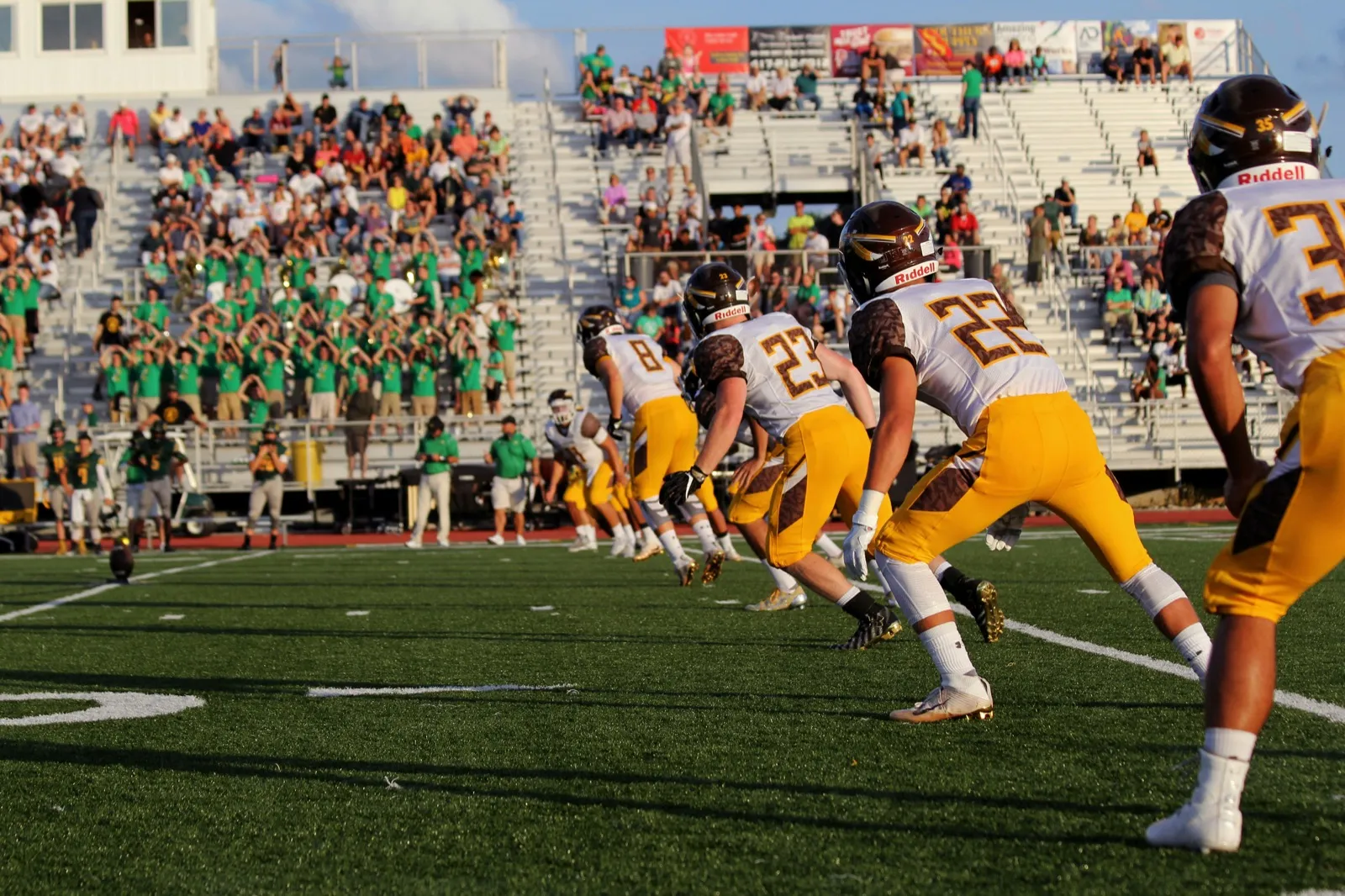
Football recruiting timelines vary more by level than any other major sport — and the gap between what families hear and what applies to their athlete is enormous.
At the FBS level, the most publicized tier of D1 football, serious evaluation happens at camps and 7-on-7 tournaments during the summer between sophomore and junior year. Offers from major programs typically begin arriving in junior fall. The early signing period (mid-December of senior year) and the regular signing period (beginning in early February) create hard deadlines that feel distant until they don't. Note: the NCAA eliminated the National Letter of Intent in October 2024 — athletes now sign institutional financial aid agreements directly, but the binding commitment and signing windows work similarly.
Below FBS, everything shifts later. FCS programs (the second tier of D1), D2 programs, and D3 programs all recruit on longer windows. A D2 football program can be actively pursuing a senior in October with nothing unusual about it. Some D3 programs fill roster spots as late as spring of senior year.
The trap: families who wait for FBS D1 interest through junior year — while every other door quietly closes — miss programs that were the right fit all along. The answer isn't to abandon D1 aspirations prematurely. It's to run both tracks simultaneously. Keep reaching out to D1 programs through junior fall, but build a real D2 and D3 list starting sophomore year. Those programs deserve genuine attention, not just backup status.
Baseball and softball: the showcase circuit is the whole game
Baseball recruiting has its own ecosystem, and it runs on a timeline that surprises most non-baseball families. The showcase circuit — tournaments where college coaches evaluate talent — is the primary mechanism, and it runs year-round. The summer before junior year is the critical evaluation window for D1 programs.
Major events like WWBA nationals and Perfect Game tournaments are where coaches build their recruiting boards. Coaches who are interested will follow up in the fall of junior year. Athletes who haven't been visible on the showcase circuit before that window are functionally unknown to D1 programs — coaches who haven't seen them compete won't extend offers based on film alone.
One thing baseball does differently from other sports: the community college pathway is legitimate and frequently used. Athletes who don't land D1 offers in high school can play two years at a quality junior college, build a statistical track record, and re-enter the recruiting market as proven college players. This isn't a consolation route — a significant number of players on D1 college rosters took the JC path first.
Softball follows similar logic. Elite club exposure through travel ball programs drives D1 evaluations, and the active offer window closes faster than most families expect. The D2 and D3 windows stay open considerably longer.
Basketball: elite D1 recruiting looks nothing like the rest
D1 men's basketball recruiting — particularly at power conference programs — begins earlier than any other mainstream sport. Elite programs evaluate players at AAU and grassroots circuit events starting in 9th and 10th grade. Top recruits commit to power conference programs by the end of sophomore year.
Outside the elite tier, the picture is entirely normal. D2 and D3 basketball programs recruit on conventional junior/senior year timelines. Mid-major D1 programs recruit later than power conference programs. A player targeting D2 or D3 who doesn't have offers by the end of sophomore year has nothing to worry about — the early-commitment pattern at the elite tier doesn't apply.
One structural reality that now affects all levels of basketball: the transfer portal has changed how D1 coaches fill roster spots. Coaches at major programs increasingly fill openings with experienced transfers rather than high school recruits. High school athletes targeting D1 basketball need to account for portal competition as a real structural factor, not background noise.
Lacrosse: men's and women's run on different clocks
Lacrosse recruiting timelines split along a gender line that matters for planning. Men's lacrosse follows the September 1 of junior year contact date — the same as football. Women's lacrosse follows the June 15 after sophomore year date that most other D1 sports use. This means women's lacrosse families need to be active earlier than men's lacrosse families at the D1 level.
For D1 women's lacrosse, the recruiting process closely mirrors soccer. Elite club programs drive visibility, and coaches evaluate at major club tournaments starting sophomore year. Verbal commitments at top D1 programs happen during sophomore and junior year. For D1 men's lacrosse, the later contact date means the active window is more compressed — coaches build their boards at summer showcases and fall tournaments during junior year, with offers typically arriving junior fall and winter.
At D2 and D3, lacrosse recruiting runs on a more conventional timeline. D3 lacrosse is particularly significant because the sport has a large D3 footprint — more D3 programs exist in lacrosse than in many other sports. D3 coaches recruit actively through junior and senior year, and many programs fill roster spots well into senior spring.
Volleyball, swimming, and track: earlier than you think at D1
These three sports share a common pattern. D1 coaches identify and recruit athletes earlier than most families expect. D2 and D3 coaches recruit on conventional timelines with significantly more flexibility.
For D1 volleyball, coaches attend national club tournaments from sophomore year. Offers at the D1 level come in junior year for most athletes. For swimming and diving, coaches visit meets starting sophomore year, and the D1 window closes for most programs by the end of junior year.
Track and field has a distinctive advantage: because the marks are public, coaches can evaluate athletes without seeing them in person. An athlete with strong times or distances can generate real interest simply by emailing coaches with their marks — no showcase appearance required. Many programs publish specific recruiting standards by event that tell you exactly what numbers get coaches' attention. For track athletes, direct outreach is more effective earlier in the process than waiting to be discovered at a meet.
In all three sports, don't let the compressed D1 timeline create panic about a D2 or D3 situation that has much more time available than the D1 framing suggests.
What to do at each grade level
Freshman year:
Understand the timeline specific to your sport and your realistic division range — the table earlier in this article is a starting point, but the sport-specific details matter. Get on the right club or travel program if you haven't already. Learn what academic requirements your target division requires; the NCAA core course rules start accumulating from freshman year and can't be fixed retroactively. Don't rush to contact coaches — relationship-building before sophomore year is rarely productive — but do use this year to get informed.
Sophomore year:
Begin researching programs and building an athletic profile. For soccer and basketball, this is already the active phase at D1 — attend showcases where coaches evaluate, start emailing target programs. For other sports, use this year to build the foundation: identify 20–30 target programs, create your film and stats profile, and prepare for the outreach that starts in earnest junior year. Early outreach to D2 and D3 programs in any sport is appropriate now.
Junior year:
For most athletes in most sports, this is the year everything happens. Reach out to coaches on your target list, attend camps and showcases, take unofficial visits to programs you're serious about. Pay close attention to response patterns — consistent silence from a division level is the market telling you something real. By the end of junior year, you should have genuine feedback from coaches about where your athlete fits.
Senior year:
If you have offers, evaluate them carefully — calculate actual out-of-pocket cost, not scholarship percentage, and understand how verbal commitments work before making any decision. If you don't have offers yet, focus your energy on programs still actively recruiting: D2, D3, and NAIA programs recruit throughout senior year. A senior without offers is not out of options — they're in the right market, just not always the right tier.
The bottom line
The college recruiting timeline is not one clock. It's six different clocks running at different speeds, each set by sport and division level. Families who understand their specific clock — what "early" means for their sport, what division range is realistic, when inaction stops being patience and becomes a problem — consistently navigate the process better than families who apply the wrong template to their situation.
If you're still getting oriented to how the overall process works, our guide to how college recruiting works maps all eight steps from eligibility to signing. When you're ready to focus your research on specific programs, our guide to building a college recruiting target list walks through filtering 1,000+ programs down to 20–30 realistic targets. And if you're wondering whether a recruiting service could simplify the process, our review of NCSA gives you a clear-eyed look at the costs and benefits.