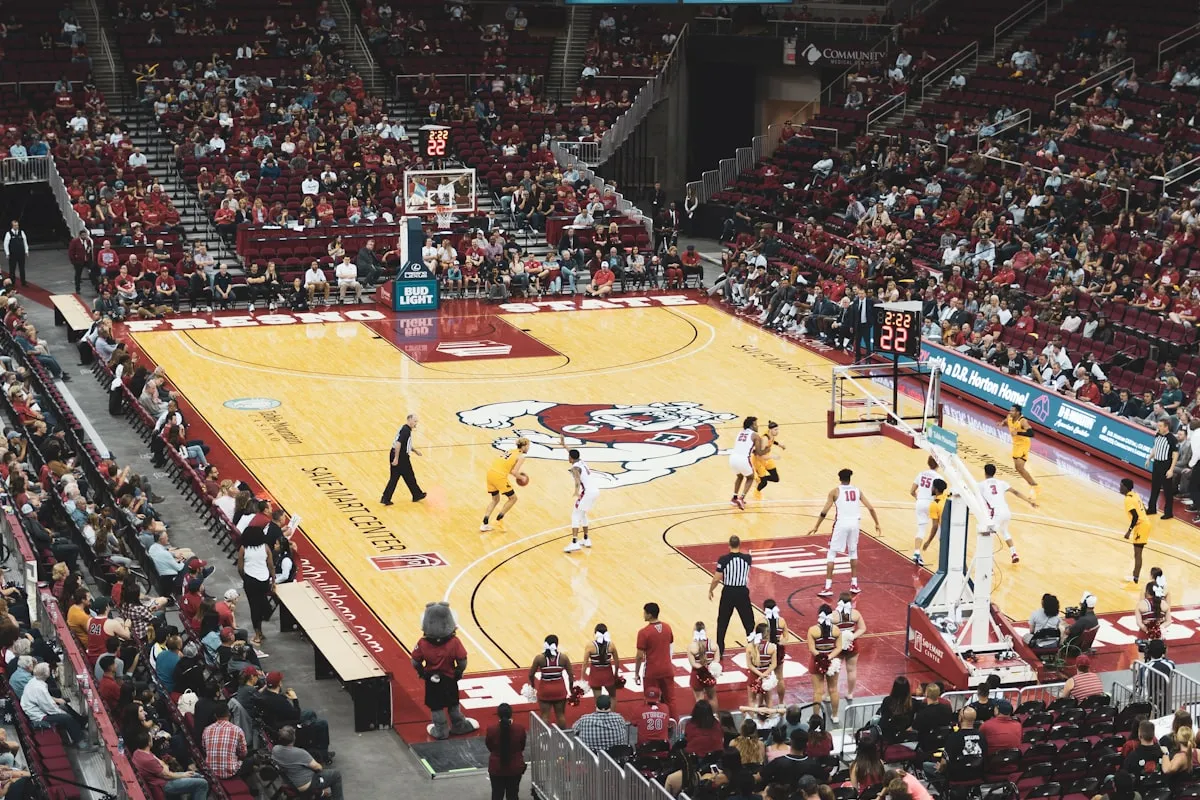
Most families hear "D1 basketball" and picture March Madness — packed arenas, ESPN cameras, coaches making seven figures. That picture is accurate for maybe 60 programs. The other 300 D1 basketball programs operate in a different world: smaller gyms, regional recruiting, and coaching staffs that are actively looking for players most families have never heard of. The phrase "D1 basketball" covers an enormous range, and understanding that range is the difference between chasing programs that were never realistic and finding ones where your athlete has a genuine path to a roster spot.
This matters because the most common mistake in basketball recruiting is not aiming too low — it is aiming at the wrong tier. A family that treats all D1 basketball programs as interchangeable will either fixate on Power conference schools where their athlete does not match the recruiting profile, or scatter outreach across 40 random programs with no strategy. Both approaches waste the limited time your athlete has to make an impression on the right coaches.
The D1 basketball landscape: how many programs exist
NCAA Division I men's basketball includes approximately 363 programs across 32 conferences. Women's D1 basketball has a nearly identical count. That is over 700 programs combined — far more than most families realize when they start searching for D1 colleges for basketball.
The scholarship structure is what makes D1 basketball distinct from almost every other college sport. Both men's and women's basketball programs operate under a 15-player roster limit. D1 basketball is a roster-limit sport, which means every scholarship must be a full scholarship — tuition, room, board, fees, and a cost-of-attendance stipend. No partial awards, no splitting. If a D1 basketball coach offers your athlete a scholarship, it is a full ride. If the scholarship slots are filled, there is nothing to offer regardless of interest. The college athletic scholarships guide explains how this structure differs from D2 and below, where the equivalency model allows partial awards.
That roster limit structure creates a specific recruiting dynamic: D1 basketball coaches treat each scholarship like a major investment. They will not offer one unless they are confident about the recruit. It also means roster spots are scarce — a men's program carries 15 players under the roster limit. Every spot matters, and coaches plan their scholarship allocation years in advance.
Power conferences vs. mid-major vs. low-major D1: what the differences mean for recruits
Conference affiliation tells you more about a D1 basketball program than the division label alone. Here is how the tiers break down and what each means for your athlete's recruiting prospects.
| Tier | Conferences | Recruiting profile |
|---|
| Power conferences | Big Ten, SEC, ACC, Big 12, Big East | National recruiting, top-100 prospects, NBA pipeline, March Madness regulars |
| Upper mid-major | AAC, Mountain West, WCC, A-10, MVC | Regional-to-national recruiting, tournament Cinderellas, strong development |
| Lower mid-major | Sun Belt, MAC, CAA, Horizon, Big West, WAC, ASUN, Southland, OVC | Primarily regional recruiting, competitive basketball, realistic targets for strong high school players |
| Low-major | MEAC, SWAC, NEC, Patriot League, Ivy League, Summit League, America East | Academic-focused or resource-limited, closer to strong D2 in competitiveness |
Power conference programs
These are the programs that dominate the NCAA tournament bracket: the Big Ten, SEC, ACC, Big 12, and Big East. They recruit nationally, pull from the AAU/grassroots circuit — Nike EYBL, adidas 3SSB, Under Armour Association — and fill their rosters with players who appear in national recruiting rankings. Their recruiting pipelines are established, their budgets are enormous, and the transfer portal has made their roster building even more targeted. Power conference coaches increasingly add proven college players through the portal rather than developing high school recruits. If your athlete is not ranked nationally, has not performed at major grassroots events, and is not generating Power conference interest by the summer before junior year, these programs are almost certainly not realistic targets.
Mid-major programs
Mid-major basketball is where most D1 opportunity actually lives. These programs recruit regionally, attend local and regional showcases, and build rosters through a combination of high school recruiting and targeted portal additions. The basketball is competitive and demanding — mid-major conferences have produced genuine March Madness runs in recent years. Loyola Chicago reached the Final Four. Saint Peter's made the Elite Eight. FAU reached the Final Four. These are not anomalies; they reflect the quality of basketball being played outside the Power conferences.
For athletes who are strong but not elite national prospects, mid-major programs represent the most realistic path to playing D1 basketball. The recruiting bar is different from Power conference programs, scholarship offers are full rides (same roster limit structure), and the playing time path is often clearer because rosters are not stacked three-deep with future pros at every position.
Low-major programs
Low-major D1 programs operate under additional constraints. Ivy League programs offer zero athletic scholarships across all sports. HBCU conference programs in the MEAC and SWAC often have limited basketball budgets despite D1 status. Other low-major conferences compete at a level closer to strong D2 programs than to Power conference D1. These programs can be excellent fits for specific athletes — a strong student who wants an Ivy League education, an athlete with ties to an HBCU, or a player who wants D1 competition with a different overall experience. But evaluate them on their actual characteristics, not on the "D1" label alone.
How to assess what level of D1 basketball is realistic for your athlete
This is the conversation most families avoid because the honest answer is often different from the hoped-for answer. Basketball makes self-assessment harder than some sports because the metrics are less standardized than in, say, baseball or track. But there are concrete ways to calibrate.
Study rosters at specific programs.
Go to the athletics website for any D1 program you are considering. Look at the roster. Where did the current players come from? What AAU organizations? What states? What were their recruiting profiles? Most D1 programs list player hometowns and high schools. If a mid-major program consistently recruits from certain AAU circuits and regions, and your athlete competes in that world, the fit may be real. If the roster is filled with players from EYBL teams and national showcases, and your athlete plays mid-level AAU, the athletic gap is probably significant.
Use the grassroots/AAU circuit as a signal.
Basketball recruiting for D1 is driven heavily by the AAU and grassroots circuit. The level of AAU program your athlete plays for — and the events they compete in — is a strong signal. Players on Nike EYBL or 3SSB teams are Power conference recruits. Players on strong regional AAU teams that compete in mid-level circuits are mid-major recruits. Players on local AAU teams that play primarily in-state events are more likely low-major D1 or D2 recruits. This is not a rule without exceptions, but it is a reliable pattern. The basketball recruiting timeline covers how the AAU calendar intersects with the D1 evaluation schedule.
Track coach response rates.
If your athlete has sent well-crafted introductory emails with film and stats to 15 D1 programs and received zero responses after 8 to 10 weeks, that is data. It does not definitively mean D1 is wrong — the emails may need work, or you may be targeting the wrong tier. But consistent silence from one tier combined with interest from the tier below is the recruiting market telling you something. An athlete who earns a full scholarship at a mid-major D1 program and plays four years of meaningful basketball has a better outcome than one who walks on at a Power conference school and never sees the floor.
Ask coaches directly at camps.
If your athlete attends a college prospect camp, ask afterward: "Based on what you saw today, what level of program is a realistic fit?" Some coaches will give you a straight answer. One honest assessment from a college coach who watched your athlete play is worth more than a year of speculation from the bleachers.
For a broader framework on evaluating fit across athletic, academic, financial, and personal dimensions, the guide to building a college recruiting target list walks through the full process.
Small D1 basketball schools: the overlooked opportunities
When families search for D1 colleges for basketball, they tend to gravitate toward names they recognize — the programs that appear on national broadcasts. That bias causes them to overlook a large population of small D1 basketball schools that offer genuine opportunities.
Programs in conferences like the NEC, Patriot League, America East, Horizon League, MEAC, SWAC, and Summit League are Division I. Their players receive the same D1 experience — NCAA tournament eligibility, conference championships, the full competitive structure. Many of these schools have enrollments under 5,000 students. The campus experience is closer to a D3 school, but the athletic competition is D1.
Why these programs matter for recruits:
Small D1 programs often have less recruiting competition for roster spots. A mid-major program with national visibility might receive thousands of recruiting emails per year. A small D1 program in the NEC or America East receives far fewer. That means your athlete's outreach is more likely to be seen, evaluated, and responded to. Coaches at these programs are actively looking for players — they do not have the deep grassroots pipelines that Power conference staffs maintain.
The academic dimension:
Several small D1 basketball conferences include academically strong institutions. The Patriot League (Lehigh, Bucknell, Colgate, Holy Cross) and the Ivy League (no athletic scholarships, but D1 competition) attract students who want both competitive basketball and a rigorous academic environment. If your athlete is a strong student, these programs offer a combination that larger D1 schools may not.
The financial reality:
At small D1 programs that offer athletic scholarships, the roster limit structure still applies — any scholarship offered is a full ride. And at smaller schools, academic merit aid and need-based grants can make the overall cost competitive even for walk-ons. Run the net price calculator at any school you are considering. A small D1 school where your athlete plays significant minutes and graduates with minimal debt is a better outcome than a bigger name where the math does not work.
Men's vs. women's D1 basketball: how the recruiting landscapes differ
Men's and women's D1 basketball operate under the same NCAA framework but the recruiting landscapes have real differences that affect how families should approach the process.
Scholarship availability favors women's basketball.
Both men's and women's D1 basketball programs now operate under the same 15-player roster limit (full rides only). With equal scholarship availability across 363 programs on each side, the structural differences between men's and women's recruiting come down to competition for spots rather than scholarship counts.
The recruiting pipeline is different.
Men's D1 basketball recruiting at the Power conference level is dominated by the Nike EYBL and grassroots circuit. That pipeline is well-established, heavily scouted, and highly competitive. Women's basketball recruiting relies more on a combination of AAU, high school play, and showcases, though the grassroots circuit for women's basketball has grown significantly in recent years. The practical effect: women's basketball recruits may have more pathways to D1 visibility beyond a single dominant circuit.
Women's basketball is growing rapidly.
The surge in women's basketball visibility — driven by increased media coverage, NIL opportunities, and record-breaking attendance — has changed the recruiting landscape. More athletes are pursuing D1 women's basketball, which means the competition for roster spots is intensifying. But it also means more resources are flowing into women's programs: larger coaching staffs, better facilities, and more recruiting attention at all D1 tiers. For families with daughters pursuing basketball, the window of opportunity at mid-major and low-major D1 programs is real, and the investment these programs are making in women's basketball is increasing.
The transfer portal affects both.
The transfer portal has reshaped roster building for both men's and women's D1 basketball. Coaches at every tier now balance high school recruiting with portal additions. For high school recruits, this means some roster spots that would have gone to incoming freshmen are now filled by experienced transfers. Factor this into your assessment: a program that added three portal players at your athlete's position last cycle may not have a spot for a high school recruit this year, regardless of talent level.

Building a realistic D1 basketball target list
A target list should not be 40 D1 programs pulled from a Google search. It should be 15 to 25 programs — possibly including D2 options — where your athlete could genuinely compete for a roster spot, afford to attend, get the education they want, and live comfortably for four years.
Start with the conference tier, not the division label.
Based on your honest assessment of your athlete's AAU level, coach feedback, and recruiting response rates, identify which conference tier from the table above is realistic. If your athlete plays strong regional AAU and has drawn some mid-major attention, anchor your list in upper and lower mid-major conferences with a few Power conference programs as reaches. If your athlete's competition history suggests lower mid-major, build the core there and add low-major D1 and strong D2 programs as genuine options.
Filter by geography and academics early.
Basketball's roster limit scholarship structure means the financial equation at D1 is simpler than in equivalency sports — if your athlete gets a scholarship, it is a full ride. But walk-on spots have no guaranteed financial aid, and academic admission standards vary widely across D1 programs. Identify schools where your athlete meets the academic profile, where the location works for your family, and where the full cost (if walking on) is sustainable. Remove programs that fail on academics or finances before you invest time in recruiting outreach.
Research roster turnover at each program.
Check current rosters and recent signing classes. How many seniors are graduating at your athlete's position? Did the program just add portal transfers at that spot? Is the coaching staff new (new coaches often reshape rosters through the portal rather than honoring previous recruiting relationships)? This information is public. A program losing two guards to graduation and a third to the portal is a better target than one that just signed three guard commits and added a portal transfer.
Include D2 programs as real options.
The gap between a low-major D1 program and a strong D2 program is smaller than the division label suggests. Understanding the real differences between D1, D2, and D3 helps you evaluate these as genuine options. A D2 program where your athlete starts as a freshman and develops for four years is a better college experience than a D1 bench where they never see meaningful minutes.
Use the reach-fit-safety framework.
Within your 15 to 25 programs, categorize each as a reach (your athlete is at the lower end of what they recruit), a fit (athletic level, academics, and finances align), or a safety (your athlete is clearly competitive and admission is likely). The fit schools should receive the most focused outreach. If your list is entirely reaches, recalibrate. If it is entirely safeties, you may be leaving opportunity on the table.
Build the list before the evaluation windows, not after.
D1 basketball coaches evaluate recruits on a structured calendar tied to the AAU and grassroots season. Your target list should be built before those evaluation periods begin so your athlete can prioritize events where target coaches will be watching. A list assembled after the summer evaluation period has missed the primary window when D1 coaches are actively scouting.
The bottom line
"D1 basketball" is not one thing. It is 363 programs spanning from nationally elite Power conference schools to small private institutions that happen to compete in Division I. The label alone tells you almost nothing about whether a program is realistic for your athlete.
The families who navigate this well assess their athlete honestly — using AAU level, coach feedback, roster comparisons, and recruiting response rates rather than highlight reels watched through a parent's eyes — and build a target list calibrated to the conference tier where their athlete actually fits. That list should include mid-major and small D1 programs as genuine targets, not consolation options. Review the basketball recruiting timeline so your outreach aligns with the evaluation calendar, and use the basketball recruiting standards guide to assess whether your athlete's measurables match what coaches at each tier actually recruit. If D1 isn't the right fit right now — or if your athlete needs a development year — the JUCO basketball path is a legitimate pipeline that produces NCAA starters every year. The goal is not the biggest name. The goal is the right program. Before paying for a service to help you search and organize programs, our review of NCSA for basketball covers what they actually offer versus what most families need.