Emailing a track and field college coach is not the same as emailing a football or baseball coach. In those sports, coaches want film, measurables from a showcase, and a highlight reel. Track coaches want marks — verified, public, searchable marks from sanctioned meets posted on TFRRS. A track recruiting email without personal records, event specifics, and a TFRRS profile link is an email that tells a coach the family doesn't understand how this sport recruits.
If you've read our guide to how to email a college coach, you have the general framework. This article gives you the track and field-specific version: what data to lead with, how to present event-group-specific information, and when in the season to send your first email for maximum impact.
What track and field coaches want to see in a first email
Track coaches evaluate athletes through data before anything else. The email needs to answer three questions in under 30 seconds:
What are your marks, and are they verified?
Personal records in your primary events — with the meet name, date, and whether the time was FAT (fully automatic timing). A hand-timed 10.8 in the 100m and a FAT 11.05 are different numbers, and coaches know the difference. If your marks are on TFRRS, include your TFRRS profile link. If they're not (because the meet wasn't sanctioned), they carry less weight — coaches treat unverified marks with skepticism.
What's the trajectory?
Coaches recruit improvement rates, not just current marks. A distance runner who went from 4:45 to 4:28 in the mile across two seasons is more interesting than a runner sitting at 4:30 with no context. Include your progression — sophomore marks, junior marks, and the improvement arc. This is the data point that separates athletes coaches want to develop from athletes who've plateaued.
What event group are you, and what's your competitive level?
Specify your primary and secondary events. A "track and field athlete" tells a coach nothing — a "400m/200m sprinter with 800m range" tells them exactly which assistant coach should evaluate you. For the marks that determine what division fits your current level, our track and field recruiting standards guide has the benchmarks.
Track-specific details that separate your email from generic outreach
Beyond the standard recruiting email elements, track coaches expect sport-specific information that other sports don't require.
TFRRS profile link.
This is the equivalent of a Hudl link in football. TFRRS is the database coaches search — and your profile shows every mark from every sanctioned meet. Including it saves the coach time and demonstrates that you understand the recruiting ecosystem. If your marks aren't on TFRRS, that's a signal to compete in more sanctioned meets.
Indoor and outdoor marks.
Track has two competitive seasons. Coaches evaluate both. If your athlete has strong indoor marks (200m, 400m, 800m, mile, 60m hurdles, jumps, throws, distance events with indoor equivalents), include them. An athlete who only competes outdoors is giving coaches half the data.
Event versatility.
If your athlete competes in multiple events, say so. A sprinter who runs the 100m, 200m, and long jumps has more roster value than a single-event specialist. A distance runner who handles the 800m, 1500m, and cross country provides more scoring depth. Multi-event athletes (decathlon/heptathlon) should list their component event marks alongside their overall score.
Cross country times (for distance runners).
Cross country results are a critical part of the distance recruiting profile. Include 5K times, course context (flat vs. hilly), and championship meet results. Coaches recruiting distance runners evaluate cross country and track as a single athletic profile.
Training context.
Coaches want to know if your athlete is self-coached, club-coached, or working with a high school program that has a track record of developing college athletes. If your athlete trains with a recognized club program or under a coach with a college development track record, mention it — it adds credibility to the projection that your athlete will continue improving.
Email template for track and field recruits
Subject line: [Name] | [Grad Year] | [Event(s)] | [PR] | [State]
Examples:
Sarah Chen | 2027 | 400m/200m | 55.8/25.1 | California2027 | Shot Put/Discus | 52'4" SP / 155' Disc | Marcus Johnson | TXEmily Rodriguez | 2027 | 5K/XC | 17:42 5K, 18:15 XC | New Jersey
The subject line should include your primary event and best mark. Coaches scanning recruiting emails make the first decision — open or skip — based on whether the mark is in their program's recruiting range.
Email body:
Coach [Last Name],
My name is [First Last], a [graduation year] [event group] at [High School] in [City, State].
I'm reaching out because [one specific, genuine reason you're interested in this program — their event-group coaching, a conference championship result, an academic program, their development track record with athletes at your event].
Personal records:
Progression:
- Sophomore year: [event] — [mark]
- Junior year: [event] — [mark]
TFRRS profile: [direct link]
Academics:
- GPA: [weighted/unweighted]
- SAT/ACT: [score]
- NCAA ID: [number]
Upcoming meets: [Next 2-3 competitions with dates and locations]
My coach is [Name] at [High School / Club], and can be reached at [email] or [phone].
Thank you for your time, Coach.
[Full Name]
[Phone Number]
[Email Address]
Two track-specific notes on this template.
First, the progression section is the most important element unique to track email outreach. No other sport asks you to show year-over-year improvement as explicitly. A coach who sees "sophomore 5K: 16:45 → junior 5K: 15:58" immediately understands this athlete is on a trajectory — and can project where that trajectory leads by college sophomore year. Include it.
Second, the "upcoming meets" section gives an interested coach an immediate action item. Unlike football or baseball, where coaches evaluate at camps or showcases, track coaches can evaluate by simply checking TFRRS after a meet — but they need to know which meets to watch for. State championships, conference championships, and invitational meets against strong competition are the events worth listing.
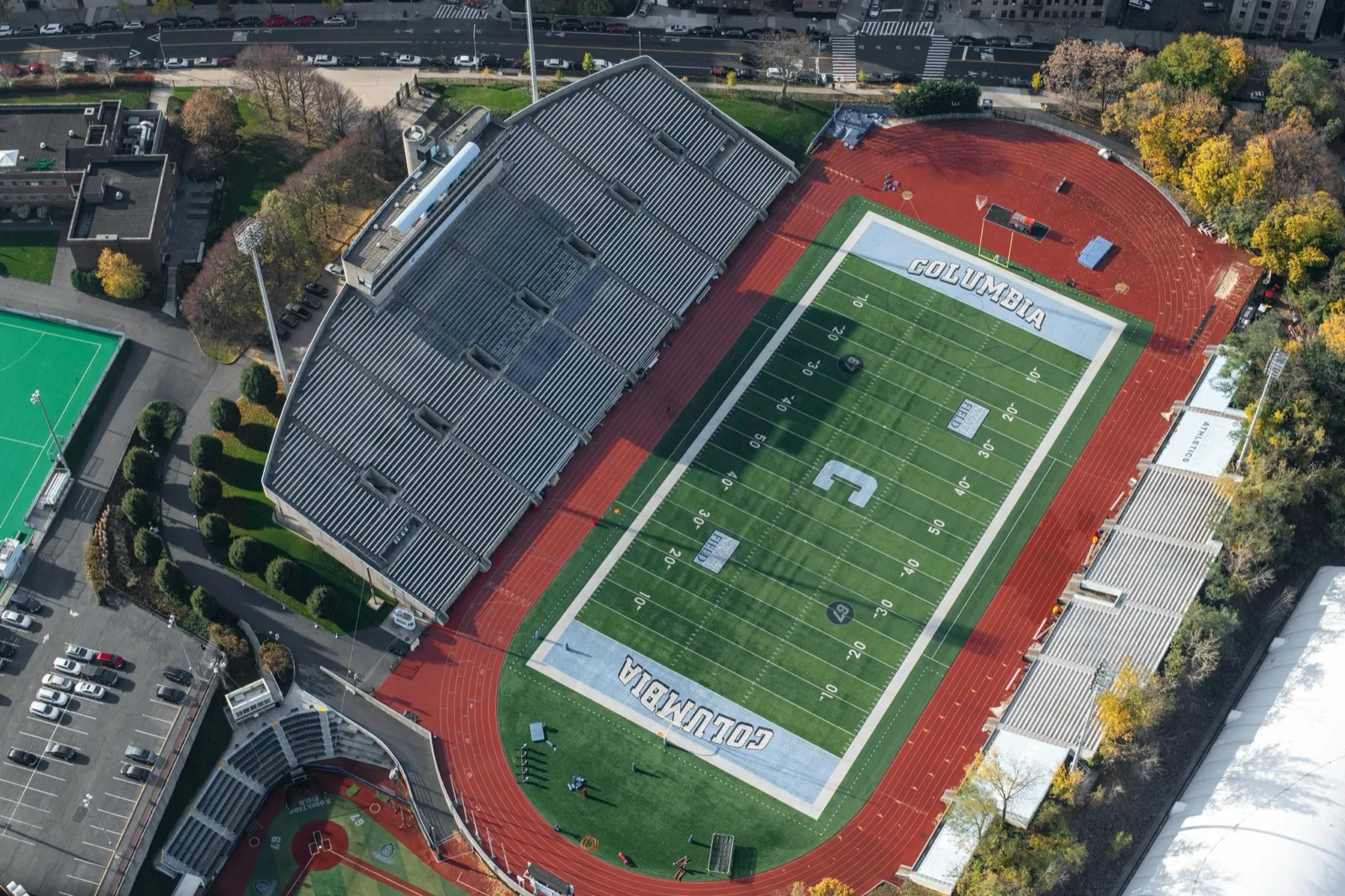
Track recruiting email timing is driven by the competitive season calendar and the NCAA contact rules.
Before September 1 of junior year (D1):
D1 coaches cannot initiate contact. But your athlete can email coaches at any time — and should. The strongest time to send an introductory email is immediately after a breakthrough performance at a major meet: a PR at the state championship, a conference title, or a strong performance at a national-level event. The email arrives when the mark is fresh on TFRRS and the context is relevant.
For D2, coaches can initiate contact starting June 15 after sophomore year — earlier than D1. An introductory email sent in spring of sophomore year, timed to coincide with early outdoor season marks, puts your athlete on D2 radars at exactly the right moment.
During indoor season (January–March of junior year):
Indoor marks hit TFRRS during a window when coaches are actively building recruiting boards. A strong indoor performance followed by an email update to target coaches is one of the highest-leverage timing moves in track recruiting. Indoor season is the least crowded outreach window — most families wait for outdoor season, giving athletes who act during indoor a communication advantage.
During outdoor season (April–June of junior year):
The primary recruiting evaluation window. Coaches are tracking TFRRS data from state and regional meets. Send email updates after strong performances — not a full re-introduction, but a brief note referencing your previous email with updated marks. "My 800m PR is now 1:54.3, down from 1:57.1 at the start of the season" is the kind of update that moves an athlete up a recruiting board.
After September 1 (junior year):
Communication opens both ways for D1. Coaches who've been tracking your marks will reach out. For athletes who haven't heard back from D1 programs by October of junior year, the D2 and D3 outreach should intensify. These levels recruit later and are highly responsive to direct outreach. For the full picture of when recruiting activity peaks at each division, see our track and field recruiting timeline.
D3 and NAIA — anytime:
No calendar restrictions. These coaches respond year-round. Don't hold outreach waiting for "the right window" — send it when you have strong marks to share.
Follow-up strategy after your first email
Track recruiting follow-up is simpler than most sports because the currency is new data — new marks.
Update after every significant performance. A PR, a championship result, or a mark that moves your athlete into a new recruiting tier — email your target list within 48 hours. Keep it short: reference your previous email, share the new mark, and include your TFRRS link. Coaches don't need a full re-introduction every time. They need the new number.
Follow up after 10–14 days if you haven't heard back. Reference your original email, ask if they had a chance to review your marks, and include any updated information. One follow-up is appropriate. Two without response is the limit before moving on.
Send seasonal updates. At the transition between indoor and outdoor seasons, send a brief update with your current PRs and upcoming outdoor schedule. At the end of outdoor season, send a comprehensive update with your final marks and plans for the next competitive window.
Read the patterns. If your athlete has emailed 30 programs at a specific division level with verified marks and thoughtful follow-ups, and received zero engagement after 6–8 weeks, the marks may not match that division's recruiting range. Recalibrating the target list is more productive than sending the same email to more programs at the same level. For guidance on interpreting what coach responses (and non-responses) actually mean, see our guide to reading college coach signals.
The bottom line
Track and field email outreach is the most data-driven coach communication in college athletics. Coaches don't need a highlight reel or a parent's description of work ethic — they need verified marks, a TFRRS profile, and evidence of improvement over time. The email that includes those elements, sent to the right event-group coach at the right time in the competitive season, opens conversations. The email without marks gets filed away.
Lead with your numbers. Show the trajectory. Include your TFRRS link. Time your outreach to the competitive season — indoor marks in winter, outdoor PRs in spring, cross country results in fall. And don't wait for perfect marks before starting outreach. Coaches recruit projectable athletes, not finished products.
For the general framework behind coach communication across all sports, our complete guide to emailing a college coach has the full template and strategy. For the marks that determine what division your athlete should target, the track and field recruiting standards guide has the benchmarks by event and division. And when coaches respond, understanding what their signals mean helps you separate genuine interest from polite non-answers. Families considering whether to hire a recruiting service rather than manage outreach themselves will find this comparison of the major options useful — it covers what these services do, what they cost, and where self-directed outreach works just as well.