Basketball coaches don't find recruits the way football or soccer coaches do. The AAU live evaluation calendar drives the entire D1 and D2 recruiting process — coaches spend specific weekends watching specific events, and the rest of the time they're restricted by NCAA contact rules from even responding to your email. If you send a strong introductory email during a dead period, it sits unread. If you send it the week before a live evaluation event and include your AAU team name, the coach knows exactly where to find your athlete that weekend.
Timing, film format, and the specific details you include all work differently in basketball than in any other sport. If you've read our guide to how to email a college coach, you have the general framework. This article gives you the basketball-specific version: the contact calendar, the template, the film that basketball coaches actually evaluate, and how outreach differs at D1, D2, and D3.
NCAA basketball has one of the most structured contact calendars in college sports. The terminology matters because it directly affects whether a coach can respond to your email — and misreading coach silence during a restricted period is one of the most common mistakes basketball families make.
Contact period:
Coaches can have in-person contact with recruits off campus, attend games, and communicate freely. This is when coaches are most responsive to email and most likely to initiate outreach of their own.
Evaluation period:
Coaches can watch athletes compete in person but cannot have off-campus contact with them. They can still email and call. The NCAA live evaluation periods in April and July — when coaches flood AAU tournaments — are evaluation periods. A coach sitting in the bleachers at your athlete's AAU game who doesn't approach afterward isn't disinterested. They're following the rules.
Quiet period:
Coaches can only have in-person contact on campus (during official or unofficial visits). Off-campus contact is prohibited. Phone, email, and text are still allowed. Much of the fall and early winter is quiet period for basketball.
Dead period:
No in-person contact at all, on or off campus. Communication is limited to phone and digital means. Dead periods typically align with the end of the college season and early summer.
Why this matters for your outreach email:
The best time to send a first email to a basketball coach is two to three weeks before a live evaluation period — specifically before the April and July AAU circuits. Your email should name the AAU team and the upcoming event where the coach can see your athlete. This gives the coach a reason to open the email (they're building their evaluation schedule) and a concrete next step (watch the athlete play that weekend). Sending a cold email in August, when coaches are in a dead period and have just finished their evaluation travel, is the lowest-response-rate window of the year.
For the full basketball recruiting calendar broken down by graduation year and division, see the basketball recruiting timeline.
What basketball coaches want to see in a first email
Basketball coaches scan recruiting emails the same way they scan a gym full of players — fast, with a clear checklist of what they're looking for. The email needs to survive a 15-second skim. Here's what they check, in order.
AAU or travel team:
This is the basketball equivalent of club league in soccer. Your AAU team name tells a coach two things immediately: the level of competition your athlete faces regularly, and where the coach can see them play in person. An EYBL or Adidas 3SSB team name in the subject line signals a high-level athlete competing against verified talent. A reputable regional AAU program tells a D2 or mid-major D1 coach that the athlete is worth evaluating at a local event. If the coach doesn't recognize the team name, the email has already lost its strongest hook.
Position and measurables:
Height, weight, wingspan (if available), and position. Basketball is a measurables-driven sport at every level. A 6'7" wing and a 5'10" point guard are evaluated on completely different criteria, and the coach needs to know which evaluation framework to apply before watching a single second of film. Include these in the subject line.
Game film — not a highlight reel:
This is the most important difference between basketball and most other sports. Basketball coaches do not want a three-minute montage of dunks and three-pointers set to music. They want continuous game footage that shows how your athlete plays within a system: ball movement, defensive positioning, transition decisions, off-ball movement, and how they respond when things break down. We cover the specific film format below.
Academics:
GPA (specify weighted or unweighted), test scores, and NCAA Eligibility Center ID if registered. Basketball coaches at every level are managing scholarship budgets and admissions thresholds. A strong academic profile expands which schools can recruit your athlete — a weak one eliminates options before the coach even watches film.
Upcoming schedule:
Specifically, AAU tournament schedule and any showcase events. A coach who is interested needs to know where they can see the athlete in person. Include the next two to three events with dates and locations.
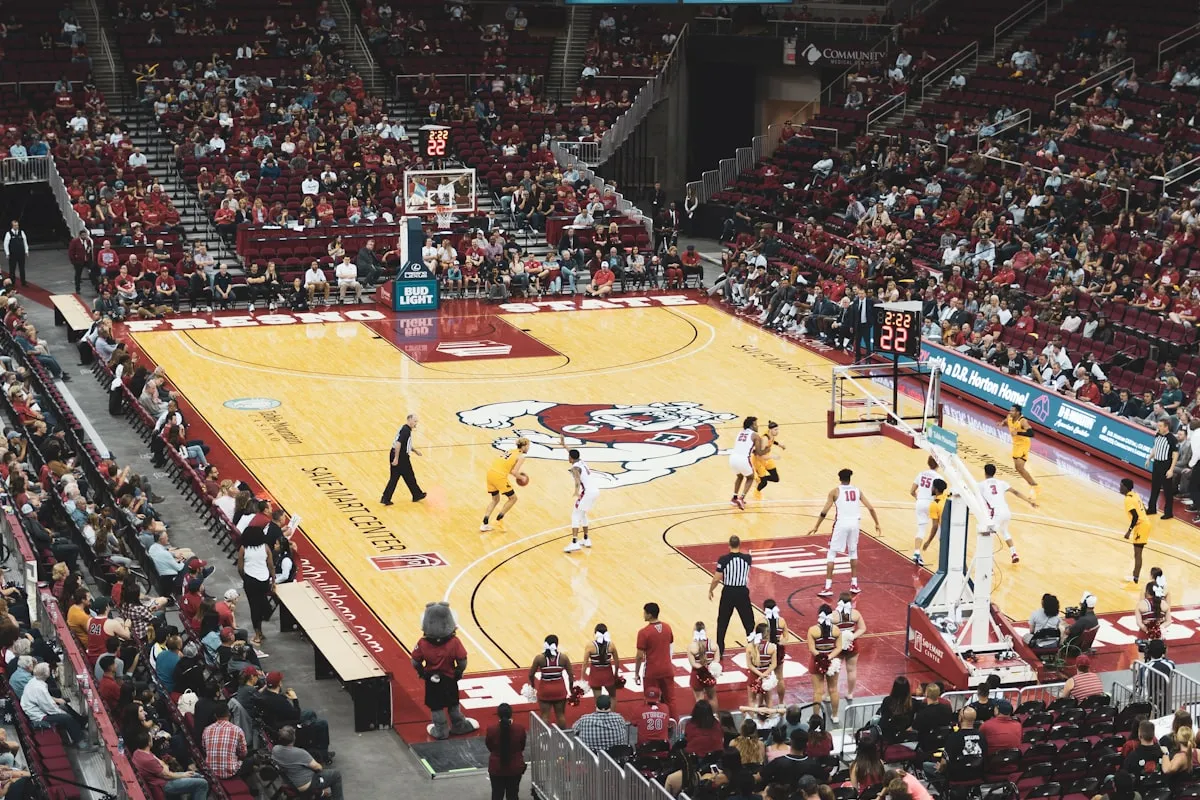
The basketball coach email template
Every element in this template exists to survive a fast scan from a coach who processes hundreds of recruiting emails during peak periods.
Subject line: [Grad Year] [Position] | [Height] | [AAU Team] | [City, State]
Examples:
2027 PG | 6'1" | Atlanta Celtics EYBL | Atlanta, GA2028 Wing | 6'5" | Texas Elite 3SSB | Houston, TX2027 Post | 6'3" | Midwest Basketball Club | Chicago, IL
The AAU team name in the subject line is basketball-specific and critical. A coach scanning their inbox during evaluation season decides whether to open the email based partly on whether they recognize the program and whether that team competes at events they'll attend.
Email body:
Coach [Last Name],
My name is [First Last], a [graduation year] [position] at [High School] in [City, State]. I play AAU for [Team Name] in the [League/Circuit]. I'm [height], [weight], with a [wingspan if known].
I'm reaching out because [one specific, genuine reason you're interested in this program — their style of play, a coaching philosophy you've researched, an academic program, a recent season result].
Film: [Direct link to game film on Hudl, YouTube, or Synergy]
Key stats (most recent season):
- [Points per game, rebounds, assists — position-appropriate stats]
- [AAU team and circuit/league]
- [Notable selections: all-conference, all-state, showcase invitations]
Academics:
- GPA: [weighted/unweighted]
- SAT/ACT: [score, if available]
- NCAA ID: [if registered]
Upcoming schedule:
- [AAU tournament name, date, location]
- [Next showcase or high school game, date, location]
My AAU coach is [Name] and can be reached at [email/phone]. My high school coach is [Name] at [email/phone].
Thank you for your time, Coach.
[Full Name]
[Phone Number]
[Email Address]
Three basketball-specific notes on this template.
First, include both your AAU coach and high school coach contact information. College basketball coaches routinely call AAU coaches to verify talent evaluations — the AAU coach's word carries significant weight because they've seen the athlete compete against known competition. The high school coach provides the character and coachability reference.
Second, the personalization sentence is the difference between an email that gets read and one that gets deleted. Basketball coaches receive hundreds of nearly identical emails. One genuine sentence about why you're interested in their specific program — their defensive system, a player they developed who plays a similar position, their academic strengths — signals that you've researched the program rather than mass-emailing every D1 school in the country.
Third, the upcoming schedule section should prioritize AAU events over high school games. College coaches build their spring and summer evaluation travel around the AAU circuit. If your athlete is playing in an event the coach plans to attend, you've just given them an immediate action item.
Basketball film requirements are distinct from every other sport. The sport is continuous, fast, and built on reads and positioning — coaches evaluate decision-making, not individual plays.
General rules:
Send 8 to 12 minutes of continuous game footage from competitive games. Front-load the strongest full sequences — not isolated plays, but stretches of 3 to 5 minutes that show how your athlete plays across multiple possessions on both ends of the floor. Include clips from at least two different games against quality opponents. A full AAU tournament game against strong competition is worth more than a highlight reel from a blowout against a weak team.
What coaches evaluate regardless of position:
Transition awareness (does the athlete sprint back on defense or admire their shot?), communication (are they directing traffic or standing silent?), body language after mistakes (do they reset or sulk?), and effort on plays away from the ball. These show up in continuous footage and are invisible in a highlight reel.
Guards (point guard and shooting guard):
Show ball-handling under pressure — not crossover moves in open space, but decision-making against a press or in pick-and-roll situations. Include sequences where your athlete runs the offense, makes the extra pass, and finds the open player on the second or third option. Coaches want to see court vision, pace control, and whether the guard can break down a defense and create for others. Shooting form and percentages matter, but a three-minute highlight of made threes tells a coach nothing about whether the player can run their system.
Wings (small forward and shooting guard):
Versatility drives evaluation. Show defensive sequences — guarding multiple positions, closeouts, help-side rotations. On offense, include catch-and-shoot plays, drives from the wing, and plays where the athlete creates off the dribble. Length and athleticism need to be visible in the context of actual play, not isolated dunks.
Post players (power forward and center):
Footwork in the post, ability to finish with both hands, positioning for rebounds, and rim protection. Include sequences showing the athlete's mobility — a modern college post player who can only operate with their back to the basket has limited recruiting value. Show pick-and-pop or pick-and-roll sequences if your athlete can shoot from mid-range or three. Defensive clips should show shot-blocking instincts, help-side awareness, and the ability to guard in space on switches.
Where to host film:
Hudl is the standard in basketball recruiting. YouTube works well as a backup. Synergy Sports is used at higher levels and some coaches prefer it. Whatever platform you use, verify the link works without requiring a login. A broken or password-protected link means the coach moves on to the next email.
For the complete guide to building recruiting film across all sports, see our highlight reel guide.
D1 vs. D2 vs. D3 basketball: how outreach expectations differ
The division your athlete targets changes who to email, what to expect, and how the email fits into the broader recruiting process.
Who to email at each level:
| Level | Who to email | Expected response rate | What drives results |
|---|
| D1 (Power Four) | Assistant coach or recruiting coordinator | Very low without AAU circuit exposure | EYBL/3SSB/UA circuit visibility, coach referrals, verified measurables |
| D1 (Mid-Major) | Assistant coach or head coach | Moderate — more receptive to direct outreach | Film quality, AAU team reputation, academic profile |
| D2 | Head coach directly | Higher — D2 coaches actively discover via email | Direct outreach, film, regional AAU exposure, academic strength |
| D3 | Head coach directly | Highest — coaches need athletes to find them | Academic fit, film, genuine interest in the school |
D1 Power Four programs:
Email alone almost never opens the door at this level. Power Four basketball coaches recruit primarily through the national AAU circuits — EYBL, Adidas 3SSB, and Under Armour Association. If your athlete isn't on one of those circuits, a cold email to a Power Four assistant is unlikely to generate a response. That doesn't mean don't send it — but pair it with your AAU coach making calls and your athlete attending the program's camp for an in-person evaluation. The email is a supplement, not the primary tool.
D1 mid-major programs:
This is where email outreach becomes genuinely effective at the D1 level. Mid-major coaches have smaller staffs and recruit beyond the top AAU circuits. They watch film from emails, attend regional AAU events, and respond to well-crafted outreach. An email that includes strong game film, a recognized regional AAU team, and solid academics can start a real recruiting conversation.
D2 programs:
D2 basketball coaches are the most responsive to direct outreach of any scholarship-offering level. Their recruiting budgets are smaller, their evaluation travel is more limited, and many of their roster additions come from athletes who introduced themselves via email. A D2 coach who receives a well-organized email with quality game film and strong academics will watch the film. At D2, your outreach email may be the single most important step in the entire recruiting process.
D3 programs:
D3 coaches recruit year-round with the fewest restrictions. They can contact athletes at any time, which means your email can land in any month and get a response. The evaluation shifts here: D3 coaches weigh academic fit and genuine interest in the school as heavily as athletic ability. A D3 email that demonstrates real research into the school's academic programs and campus culture — not just the basketball team — performs better than a purely athletic pitch. D3 coaches can also advocate for recruits in admissions at selective schools, making the academic connection a recruiting advantage, not just a formality.

What to do when a basketball coach doesn't respond
Silence is the default in basketball recruiting, not the exception. Coaches manage recruiting across multiple graduation years while running their current season, and the NCAA contact calendar means there are stretches where coaches physically cannot respond even if they want to.
Check the calendar first.
Before interpreting silence, verify whether the coach is in a dead period or a restricted contact window. An email sent in late June may not get a response until after the July evaluation period ends. That's not rejection — it's the calendar.
Follow up once after two to three weeks.
Reference your original email and bring something new: an updated stat line, a strong tournament performance, new film, or an upcoming event where the coach can see your athlete. The strongest follow-up hook in basketball is a specific upcoming AAU event. "We'll be competing at the [Event Name] in [City] on [Date] — I'd welcome the chance for you to evaluate me in person."
Send performance updates after strong showings.
A standout weekend at an AAU tournament is worth an email the following Monday with a brief recap and a link to updated film. Timeliness matters — coaches process evaluation notes early in the week after weekend events.
Space ongoing communication every two to three weeks.
Each follow-up should include new, substantive information. Updated stats, new game film, improved test scores, a tournament result, or a playoff schedule. "Just checking in" without new content is noise.
Read the patterns.
If your athlete has emailed 30 programs at a specific level with thoughtful follow-ups and received zero responses after six to eight weeks outside of dead periods, that's meaningful data. The division targeting may be too high, the film may not show what coaches need to see, or the AAU team level may not match the programs being targeted. Recalibrating the target list in junior year beats discovering a mismatch in senior year. For more on interpreting what coaches are telling you — and what their silence means — see our guide to reading college coach signals.
The bottom line
Basketball recruiting runs on the AAU calendar. The email itself is one piece of a process that includes circuit exposure, game film evaluation, coach-to-coach calls, and in-person events. But the email is what starts the conversation — and a basketball-specific email that arrives at the right time, names the right AAU program, and links to the right kind of film gives a coach everything they need to decide whether your athlete is worth watching.
Send the email two to three weeks before an evaluation period. Name the AAU team. Link to continuous game footage, not a highlight reel. Include both coaches' contact information. Follow up with new content, not empty check-ins. And if the responses aren't coming, adjust the target list before senior year.
For the full basketball recruiting calendar — timelines, AAU circuits, and how coaches evaluate at each level — our basketball recruiting timeline covers the complete landscape. For the general principles behind coach communication that apply across every sport, our complete guide to emailing a college coach has the full framework. And when coaches do start responding, understanding what their signals mean will help you figure out which conversations are real and which are polite non-answers. Some families hire recruiting services to handle coach communication — here's a comparison of what's available and whether it's worth the cost.